 Français
 Deutsch
 Italiano
 Português
 Español


Con Dao Prison: 113 years behind the island's walls
What Con Dao Prison was, what you will see in the French and American tiger cages, which sites to prioritise, how to fit them into a two- or three-day island stay and how to visit Hang Duong Cemetery respectfully after dark, with or without a local guide.
Con Dao Prison: the history and memory of Vietnam's island jail
In July 1970, a young American congressional aide landed on Con Son island with a hand-drawn map in his pocket. It had been sketched by a former prisoner, and it led to a door that the official tour was never meant to open. What lay behind it would put Con Dao Prison on the front pages of the world, and it still shapes what travellers come to see on this quiet island today.

What Con Dao Prison actually was
The name suggests a single building, but Con Dao Prison was never one jail. It was a whole island organised around detention: walled camps, isolation blocks, stone quarries, a lime kiln, a pier built by forced labour and an administrative quarter for the officials who ran it all. The French called the archipelago Poulo Condore, and for several generations of Vietnamese the name meant exile.
Two figures are often confused. Vietnamese official sources refer to roughly 200,000 detentions over 113 years and about 20,000 people who died on the island. The first number counts periods of imprisonment rather than individuals, because the same person could be deported more than once. Some travel articles merge the two and write that "20,000 prisoners" were held here, which understates the scale of the system considerably.
Most of those held were political prisoners. Among them were reformist scholars such as Phan Chu Trinh and Huynh Thuc Khang, and several men who later led unified Vietnam, including Ton Duc Thang, Le Duan and Pham Hung. Far more numerous, though, were ordinary people: farmers, students, teachers, monks and women arrested for political activity or simply for being suspected of it.
A timeline of Con Dao Prison, 1862–1975
|
Year |
What happened |
|
1862 |
On 1 February, Admiral Bonard, head of the French administration in Cochinchina, signs the order creating a penal settlement on Poulo Condore. Phu Hai, the first camp, is built. |
|
1883 |
Prisoners stage the Bai Canh uprising, one of the earliest recorded revolts on the island. |
|
1916 |
Phu Son camp is built next to Phu Hai, expanding capacity. |
|
c. 1940 |
The French build the first "tiger cages" inside Phu Tuong camp, hidden between two other compounds. |
|
1955 |
After the French withdrawal, the prison passes to the Republic of Vietnam, which renames the camps with the "Phu" names used today. |
|
1962–1973 |
Phu Phong camp operates; in its later years it holds women prisoners. |
|
1970 |
A US congressional visit exposes the French-built tiger cages; photographs appear in Life on 17 July. |
|
1971 |
A new isolation compound with 384 cells, later known as Phu Binh, is built with American contractors and funding. |
|
1975 |
On the night of April 30 to May 1, coinciding with the liberation of Saigon, political prisoners in Phu Binh and across the island staged a coordinated uprising, seizing control and forever ending 113 years of the prison system. |
|
1979 / 2012 |
The site is listed as a national monument in 1979, then raised to Special National Relic status on 10 May 2012. |
Why the French chose an island
Isolation was the point. Con Son lies far out in the East Sea, with no regular crossings in the nineteenth century and strong currents and seasonal winds that made escape by boat extremely dangerous. The sea did the work of a perimeter wall. Distance from the mainland also cut prisoners off from their families, their networks and any political movement they might have belonged to.
The penal colony was an economy as well as a jail. Prisoners quarried stone, built roads and the structures that would confine them, burned coral into lime and worked plantations that supplied the administration. This is why so many memorial sites on Con Son lie outside the camp walls: the pier, the lime kiln at Lo Voi and the unfinished Ma Thien Lanh bridge are all remnants of forced labour, and local sources attribute hundreds of deaths to each project.
The tiger cages and the visit that exposed them
"Tiger cages" (chuồng cọp in Vietnamese) are the most famous feature of Con Dao Prison, and the most misunderstood. They were not open-air pens. They were rows of narrow cells roofed with iron bars, beneath a walkway from which guards could watch the prisoners below, as one might look down into an animal enclosure. There are two separate sets, built three decades apart, and it helps to keep them distinct.

How the French cages were built
The French built the first tiger cages around 1940, although contemporary American reports gave 1939, inside Phu Tuong camp. The block was concealed behind double walls and placed between two compounds, so that prisoners moved into it could not easily work out where they were. Each cell measured roughly 1.45 by 2.5 metres and held several prisoners at once. From the walkway, guards could strike prisoners with poles or drop quicklime through the bars. Next to the cages stood a further row of roofless cells, exposed to sun and rain.
Walking that walkway today is one of the quietest moments of any visit. You look down from exactly where the guards stood.
July 1970: the map, the door and the photographs
In 1970, President Nixon sent a group of congressmen to South Vietnam to report on the pacification programme, and a prison visit formed part of the itinerary. Tom Harkin, an aide to the group, persuaded two members, Augustus Hawkins of California and William Anderson of Tennessee, to investigate reports of torture on Con Son. They were accompanied by Don Luce, who worked for the World Council of Churches and acted as interpreter, and by Frank Walton, the American official advising on South Vietnam's prisons.
On the island, the group left the planned route and followed the former prisoner's map to an unmarked door. A guard inside heard voices and opened it. Behind the door, the visitors found prisoners shackled in the cells beneath the bars, calling out for water; many had sores and injuries. Harkin photographed what he saw, and the images ran in Life magazine on 17 July 1970.

The reaction in Washington
The story did not unfold neatly. Some members of the wider delegation argued that the prison findings would embarrass the government and overshadow the rest of the mission, and Harkin later left the committee staff, accusing it of suppressing what the group had found. Walton had earlier written a fact sheet describing Con Son as a correctional institution worthy of higher ratings than some prisons in the United States. The US Embassy in Saigon insisted that the prison system was entirely a matter for the South Vietnamese Ministry of the Interior.
Opinions in Congress split. Soon after the Life feature, Representative Philip Crane of Illinois visited the island and declared the cages "cleaner than the average Vietnamese home." Others, including Senator Robert Byrd, called the outcry justified and welcomed Saigon's announcement that the tiger cages would no longer be used. Accounts of how many people were moved out vary: Luce later wrote of 180 men and 300 women, while the congressmen at the time reported around 400 prisoners crowded into the cells.
For English-speaking travellers, this is often the most striking part of the story. The tiger cages are not only a Vietnamese memorial; they are also a chapter of American political history, and Tom Harkin went on to serve for three decades in the US Senate.
Phu Binh: the tiger cages built in 1971
Closing the French cages did not end isolation on Con Son. In 1971 the Saigon administration built a new compound, originally Camp 7 and renamed Phu Binh after the 1973 Paris Peace Accords. Newspapers at the time reported that the construction contract went to the American consortium RMK-BRJ, funded through US military assistance channels. Prisoners called the result the "American tiger cages".
The compound covers more than 25,000 square metres and holds 384 isolation cells, arranged in four sections (AB, CD, EF and GH), each with two rows of 48 cells. From the entrance it looks unremarkable: a barbed-wire fence, a kitchen, a storeroom and a dispensary. The concrete cells behind are about five square metres each, with no sleeping platform; prisoners lay on the bare floor.

Life inside: study, solidarity and the women of Con Dao
Reducing Con Dao to a catalogue of cells misses the human side of the story. Prisoners organised daily life, taught one another to read and write, discussed history and politics, and copied texts by hand. Books, dictionaries and improvised objects became ways of staying in touch between camps. Despite the intolerable conditions, political prisoners transformed this 'hell on earth' into a 'revolutionary school.' Within the cell blocks, communist cadres organized literacy classes, political education, and secret news networks, turning places of punishment into centers of intellectual resistance and solidarity.
Women's experience of Con Dao is rarely covered in English-language guides. From the 1960s, Phu Phong camp increasingly held women prisoners, and 494 women were still detained on the island when it was liberated in 1975. One of the best-known was Thieu Thi Tao, arrested as a teenager and held in the tiger cages in the period when the congressional delegation found them; her story later reached American readers through the writer Grace Paley. Among the objects preserved on the island are handkerchiefs embroidered by women prisoners, small pieces of patient work made in cells.
Conditions were brutal: hunger, disease, isolation and physical punishment. Yet former prisoners' testimonies also speak of shared food, messages passed from cell to cell and older inmates protecting younger ones.
From prison to memorial site
After 1975 the camps were preserved rather than demolished. The complex was listed as a national historical monument in 1979, covering 17 component sites, and on 10 May 2012 it became a Special National Relic, with a protected area of more than 110 hectares. Administratively, Con Dao is now a special zone under Ho Chi Minh City, so older guides that place it in Ba Ria–Vung Tau province are out of date.
Visiting Con Dao is a deeply moving and educational experience. Signage and local guides honor the unbelievable resilience of Vietnamese patriots, referring to them as 'heroes' and 'martyrs' who suffered under brutal colonial and wartime regimes. For Vietnamese people, a visit here is a sacred pilgrimage to pay tribute to national heroes. For international visitors, examining both Vietnamese records and mid-20th-century international reporting, such as the 1970 Life magazine expose, provides an unforgettable, multi-faceted look at one of the harshest penal systems in modern history.
The two narratives rarely use the same words, but on the essential point they agree: for more than a century, people were held on this island in conditions that no one now attempts to defend. Reading the site with both perspectives in mind does not weaken its impact. If anything, it makes the testimony harder to dismiss, because the evidence comes from so many directions at once.

Which prison sites to prioritise
The heritage area is compact and most sites lie in or near Con Son town. If your time is limited, this is a sensible order of priority.
|
Site |
What you see |
Why it matters |
Suggested time |
|
Governor's Palace |
Colonial residence and offices |
Shows who held power over the island |
30–45 minutes |
|
Phu Hai camp |
The oldest and largest camp, with life-size figures in the dormitories |
Everyday reality of detention |
45 minutes |
|
French tiger cages (Phu Tuong) |
Walkway over the barred cells |
The site exposed in 1970 |
30–45 minutes |
|
Phu Binh camp |
The 1971 isolation compound |
How the system changed after 1970 |
30 minutes |
|
Hang Duong Cemetery |
Graves of prisoners who died on the island |
The living memory of the prison |
45–60 minutes, ideally in the evening |
|
Pier 914 and Lo Voi lime kiln |
Forced-labour sites |
The prison beyond the walls |
If you have extra time |
Hang Duong Cemetery after dark
Part of the wider heritage area of Con Dao Prison, Hang Duong Cemetery is where the island's history becomes most present. It covers roughly 20 hectares, shaded by the casuarina trees that give it its name, and holds nearly 2,000 graves, many of them unnamed. Among those buried here are prominent revolutionary leaders such as Le Hong Phong and Nguyen An Ninh, as well as Heroine Vo Thi Sau—a young guerilla fighter executed by the French in 1952 at the age of 19, whose bravery made her an enduring national icon of patriotism.
By day the cemetery is calm and orderly. At night it changes character. From around 9 pm, families and tour groups from across Vietnam arrive to pay their respects, and the paths fill with soft light and incense smoke. For most foreign visitors it is the moment that makes the prison's history feel current rather than historical. You are not expected to take part in any ritual; quiet observation, modest clothing and patience in the queues at the most visited graves are enough.
Since 2026 the cemetery has also had an online map that locates individual graves, designed mainly for families searching for relatives.
Visiting Con Dao Prison today
A sensible route
Start with the Governor's Palace for context, then move to Phu Hai for daily life in detention, the French tiger cages for the events of 1970, and Phu Binh to see how the system was rebuilt. Keep Hang Duong Cemetery for the evening, either the same day or the next. A morning start is sensible: the heat builds quickly, and several sites are partly outdoors.
Music lovers may want one extra stop. In spring 1895, the composer Camille Saint-Saëns spent several weeks on the island as a guest of the prison administrator, lodging in the guesthouse now known as Cong Quan. There he completed Brunehilda, an unfinished opera by his friend Ernest Guiraud, which premiered in Paris in December 1895 as Frédégonde. It is a startling contrast: one of the great composers of the nineteenth century at work a few hundred metres from the cells.

Etiquette and photography
These are memorial sites and, in the case of Hang Duong, a working cemetery. Cover shoulders and knees, keep voices low, and photograph with discretion: posed or smiling selfies in front of the cells are widely seen as disrespectful. At the cemetery in the evening, avoid blocking people who are praying.
Visiting with children, and as a veteran or veteran's family
The life-size figures and some reconstructions can upset younger children; with teenagers, the visit can open a valuable conversation about twentieth-century history. It helps to explain beforehand what they will see.
For veterans of the Vietnam War and their families, Con Dao can be an intense experience. The interpretation on site reflects Vietnam's official reading of the war, including strong language about colonialism and imperialism. Knowing this in advance, and ideally visiting with a guide who can offer context from several perspectives, makes the day easier to process.
How Con Dao compares with Hoa Lo, Cu Chi and the War Remnants Museum
Many travellers interested in twentieth-century Vietnam combine several memorial sites. Hoa Lo Prison in Hanoi covers urban detention under the French and later the captivity of American pilots, the "Hanoi Hilton". In Ho Chi Minh City, the War Remnants Museum and the Cu Chi Tunnels present the war from the perspective of civilians and guerrilla fighters.

Con Dao Prison differs in three ways. It spans more than a century rather than a single war. It is a whole landscape rather than one building, with camps, piers, quarries and cemeteries to be read together. And it takes effort to reach: a flight or a dedicated sea crossing from the mainland, which makes it a deliberate choice rather than a stop on the way. If your time is short, one site visited properly is worth more than three seen in a hurry. With more time, visiting Con Dao after Hoa Lo or Cu Chi reveals both the continuities and the differences.
A place that changes how you see the island
Con Dao Prison is not an attraction to tick off a list. It is a set of real places, preserved and open to visitors, that allow you to read a large part of Vietnam's modern history through walls, cells, piers and graves. Seeing them does not make the island's beaches and forests less beautiful, but it does give them depth. You begin to understand why Con Dao matters so much to Vietnamese visitors, and why, late in the evening at Hang Duong, the lights stay on.
Frequently asked questions
Where is Con Dao Prison?
Con Dao Prison is on Con Son, the main and only inhabited island of the Con Dao archipelago in the East Sea off southern Vietnam. The camps and the Governor's Palace are clustered in and around Con Son town and are easy to reach on foot or by short transfers.
What are the tiger cages at Con Dao?
They are isolation cells roofed with iron bars and watched from a walkway above. The French built the first set around 1940 inside Phu Tuong camp; they were exposed internationally in 1970. A second compound of 384 cells, Phu Binh, was built in 1971.
How many people were held at Con Dao Prison?
Vietnamese official sources estimate around 200,000 detentions between 1862 and 1975 and about 20,000 deaths. The first figure counts periods of imprisonment rather than individuals, because some prisoners were deported to the island more than once.

Who discovered the tiger cages in 1970?
In July 1970, congressional aide Tom Harkin, Representatives Augustus Hawkins and William Anderson and interpreter Don Luce left their planned tour and used a former prisoner's map to find the cages. Harkin's photographs were published in Life magazine on 17 July 1970.
How long does it take to visit Con Dao Prison?
Allow half a day for the main sites: the Governor's Palace, Phu Hai camp, the French tiger cages and Phu Binh camp. Hang Duong Cemetery and the forced-labour sites are best added at a different time, ideally the cemetery in the evening.
Can you visit Hang Duong Cemetery at night?
Yes. Evening is the busiest time, especially from around 9 pm, when Vietnamese families and groups come to pay their respects. Foreign visitors are not expected to take part in any ritual; quiet observation and modest clothing are enough.
Is Con Dao Prison suitable for children?
It depends on their age and sensitivity. The life-size figures and some reconstructions can upset younger children, while teenagers often find the visit a valuable starting point for talking about twentieth-century history. It helps to prepare them beforehand.

Adding Con Dao Prison to your Vietnam journey
Con Dao is reached by a short flight from Ho Chi Minh City and suits a stay of two or three days, balancing the memorial sites with the beaches and forests of the national park. If you are thinking of including it in your trip, our Vietnam Original Travel team can help you place it at the right point in your itinerary, with a guide who can put the historic sites in context. To prepare a tailor-made proposal, it helps to share your approximate dates, the number of travellers, the pace you prefer and the themes that interest you most.

Thao is a senior travel consultant and tour designer at Vietnam Original Travel. With a deep passion for sustainable tourism and personalized service, she crafts tailor-made itineraries that balance adventure, culture, and relaxation. Thao finds joy in transforming travel dreams into memorable experiences — from romantic escapes in Hoi An to family adventures in the northern mountains.
Send us your comments about : Con Dao Prison: 113 years behind the island's walls
Required fields*
You may also like
You may also like

Sam Mountain in Chau Doc: A Sacred Journey Through the Mekong Delta
Discover Sam Mountain in Chau Doc, a sacred Mekong Delta landmark surrounded by temples, rice fields and Cham villages. Explore its spiritual heritage, local culture, food and nearby attractions.

Senior Travel in Vietnam: A Gentle Journey Through Culture, Nature and Local Life
Discover senior travel in Vietnam through slower, more comfortable journeys blending culture, nature, cuisine and local encounters, with cruises, wellness and travel tips

St. Joseph’s Cathedral in Hanoi: A Living Symbol of Faith, History and Everyday Life
Discover St. Joseph’s Cathedral in Hanoi, a historic Gothic landmark in the Old Quarter where French colonial heritage, Catholic faith and everyday Hanoi life come together.
Travel ideas
Need some inspiration? Discover some of the best tours in Vietnam, which are highly appreciated by our clients. An excellent starting point to help you choose the right trip to Vietnam, Laos, Cambodia, Burma or Thailand, whether you are traveling alone, as a couple, as a family or with friends.
And because this trip is yours, feel free to customize it as you wish!
Vietnam Itinerary 2 Weeks
Hanoi - Ninh Binh - Lao Cai - Sapa - Muong Hum market - Ha Long Bay - Hue - Danang - Hoi An - Saigon - Mekong Delta - Cai Rang floating market - Departure

The Best of Ha Giang Trekking Tours
Discover Ha Giang on trekking tours where you live local life, enjoy breathtaking views and escape the crowded routes.

Vietnam and Laos 14 days
Saigon - My Tho - Da Nang- Hoian – Hue - Hanoi - Halong Bay - Vientiane Luang Prabang - Pak Ou – Khuang Si - Luang Prabang – Departure
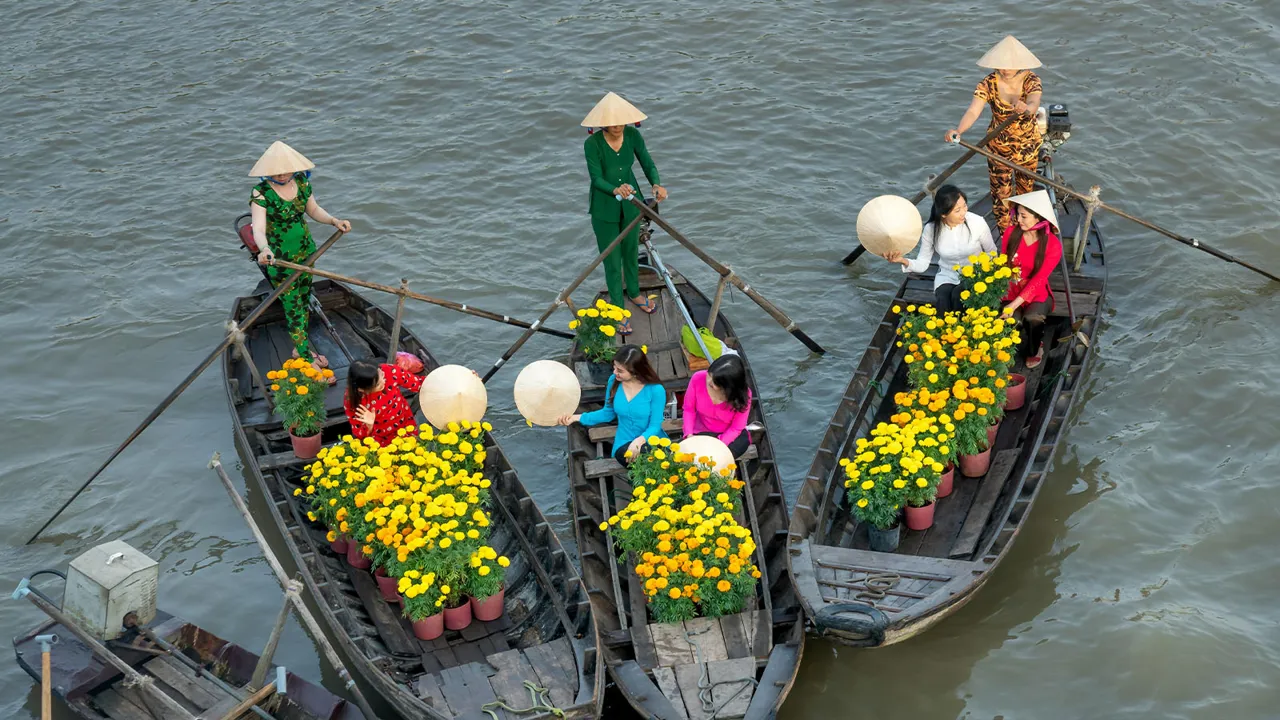
Vietnam Cambodia Itinerary 14 Days
Hanoi – Hoa Binh – Mai Chau – Ninh Binh – Halong bay – Hue - Danang – Hoian – Saigon – Ben Tre - Can Tho – Saigon - Siem Reap Angkor - Tonlé Sap - Siem Reap – Ta Prohm - Departure

Authentic Hoang Su Phi Trekking Tours
Hoang Su Phi trekking tours take you to stunning terraces, meet few tourists, connect with locals and enjoy authentic culture.

Honeymoon Tour Packages In Vietnam 12 Days
Saigon Arrival - City Tour – Mekong Delta – Danang – Hoian - by flight - Da Nang – Hanoi - by flight – Halong - overnight on junk – Departure
Are you interested in this tour?


Our testimonials
Whether it's a short or long tour, to discover must-see sites or to travel less-traveled paths, by car, junk, on foot, by bike or by motorbike... upon their return from their trip to Indochina, our clients tell us about their experiences. We thank them for entrusting us with the organization of their stay in Vietnam, Cambodia, Laos, Thailand and Myanmar!
Tailor-made trips to Vietnam
Are you a couple, a family, a group of friends? Are you planning a trip to Vietnam and/or Southeast Asia? Or maybe you want an individual, personalized trip, operated directly by a local agency? Perhaps you're thinking of a customized trip accompanied by a perfectly French-speaking guide and a private car with a professional driver... Are you the kind of traveler who likes to go where others don't? Our tailor-made tours adapt to your desires, your choices, your pace and your budget.... You decide, we create a trip that suits you!


Don't miss anything from Southeast Asia
The press talks about us




Comment
No comments yet. Be the first to leave a comment!