 Français
 Deutsch
 Italiano
 Português
 Español

Mang Den, the pine highland where Vietnam slows down
Mang Den: a cool pine plateau in Vietnam's Central Highlands
At seven in the morning the mist is still caught between the pines, and the only sound on the road down to the lake is a scooter heading for the fields. Mang Den, a pine-covered plateau about 1,200 metres up in the Central Highlands, runs on a different rhythm from the beaches and old towns that fill most Vietnam itineraries. The air is cool, the lakes are quiet, and the villages still revolve around a communal house. It is a place to slow down for a night or two rather than tick off sights. This guide covers what to see in Mang Den, when to go, how to reach the plateau from Pleiku or the coast, and which kind of trip it really suits.

Where Mang Den is and what changed in 2025
Mang Den sits on a plateau of the Truong Son range, in the northern part of the Central Highlands that Vietnamese travellers call Tay Nguyen. The name is usually traced to a word in the Mo Nam language for a broad, flat stretch of land, a fair description for anyone arriving after the switchbacks of the pass.
For decades the area was barely known even inside Vietnam. That has changed quickly. Visitor numbers climbed from about 120,000 in 2021 to around 1.2 million in 2024, and close to 2 million arrived in 2025, almost all of them domestic. A national master plan approved in October 2024 runs to 2045, and local plans aim for national tourism zone status by 2030. International travellers remain a small share of the crowd, which is both the charm and the limit of Mang Den.
Mang Den, Quang Ngai province: a new address since July 2025
On 1 July 2025 Kon Tum province merged into Quang Ngai province. Mang Den is now a commune of the enlarged Quang Ngai province, formed from the former Mang Den town and the communes of Mang Canh and Dak Tang in the old Kon Plong district. Many maps, older guides and booking platforms still read "Kon Plong, Kon Tum". It is the same place, and the change is worth remembering when comparing information from different years.

Pines, lakes and "seven lakes and three waterfalls"
The landscape alternates pine woods, clearings, small rice fields and plots of cool-climate vegetables, with older forest closer to the centre. Much of the pine cover is believed to date back to plantings in the early twentieth century, when French surveyors introduced the trees, and more than 4,000 hectares of old pine forest now blanket the plateau. Local folklore around Mang Den speaks of "seven lakes and three waterfalls", and most of the main sights lie within about 15 km of the centre. A well-planned day therefore covers most of them without rushing.
Mang Den vs Da Lat: two highlands, two rhythms
Within Vietnam, Mang Den is often called "the second Da Lat". The comparison helps with orientation but can set the wrong expectations.
|
Criterion |
Mang Den |
Da Lat |
|
Altitude |
about 1,200 m |
about 1,500 m |
|
Atmosphere |
small, fast-growing centre with a rural rhythm |
established tourist city with evening life |
|
International visitors |
few |
many |
|
English spoken |
limited |
widespread |
|
Access |
flight to Pleiku, then about 2 hours by road |
airport close to the city |
|
Best for |
nature, silence, travellers who know the classic stops |
first trips, comfort, variety of activities |
Da Lat remains the easier base for anyone wanting plenty of organised activities. Mang Den suits a quieter stay, ideally as one stop within a longer route through central Vietnam. Services are fewer, so transport is best arranged in advance, with room left for unplanned downtime.
Things to do in Mang Den: the main sights
Pa Sy waterfall
The most photographed spot in Mang Den lies about 10 km west of the centre. Three streams meet here and the water drops roughly 50 metres into a green gorge. From the car park a suspension bridge leads to around 300 steps down to the base. The descent is short, the climb back takes some breath, and anyone with sore knees can stay at the upper viewpoint. In the rainy months the flow is spectacular but the steps turn slippery. After heavy rain, access and stream conditions are worth checking locally, since landslide debris blocked streams around the falls in late 2025.

Dak Ke lake and the Mang Den cherry blossom season
Dak Ke is a small lake of about three hectares ringed by pines, a few minutes from the centre. Early morning and sunset are the best times for a walk. From late December to early February the shore turns pink with Himalayan wild cherry blossom, known locally as mai anh dao. An estimated 20,000 of these trees grow around the district, and each bloom lasts only two to three weeks. This is also when Dak Ke becomes the busiest spot on the plateau. Toong Dam lake offers a quieter alternative, and smaller lakes dotted among farms reward the curious.
Our Lady of Mang Den
For Western visitors this may be the least expected stop. On a pine-covered hill beside National Road 24, a small concrete statue of Our Lady of Fatima, about a metre tall, has become a pilgrimage site for the Catholic diocese. Locals sometimes call it the statue with the damaged arm, a reference to wear over the decades before its restoration in 2002. Beyond its religious meaning, the hill is one of the best cloud-watching points on the plateau at dawn. It is a place of prayer, so modest clothing and a low voice are appreciated.

Khanh Lam pagoda at sunset
Built on a hilltop, Khanh Lam pagoda blends Vietnamese Buddhist architecture with elements of the nha rong, the tall-roofed communal house of highland peoples. A large statue of Quan Am, the bodhisattva of compassion, stands among the pines. Late afternoon is the best time to climb, when low light filters through the forest and the terrace becomes a natural sunset viewpoint.
Kon Pring and the community villages
The plateau has been home for centuries to several ethnic groups, including the Mo Nam (often regarded as a branch of the Xo Dang), the Ca Dong, the Hre and the Ba Na. Kon Pring, about 3 km from the centre of Mang Den on National Road 24, is one of the recognised community-based tourism villages, along with Vi Ro Ngheo, Kon Chenh and Kon Vong Kia.
These are lived-in villages rather than open-air museums. A visit works best when it is unhurried and, where possible, led by a local guide who can act as a bridge. Asking permission before photographing people or interiors, staying out of homes unless invited, and buying textiles or farm produce directly rather than handing out money to children are all part of visiting well.

Mang Den pass and the clouds
Travellers coming from Kon Tum climb the last kilometres along Mang Den pass, a mountain road through pine woods, gorges and hills covered in wild cane. From March, when the dry season begins, low cloud often fills the valleys at sunrise. On the other side of the plateau, the road towards the coast descends the Violak pass, which is known for its cloud views at first light. Sleeping in Mang Den and setting out early is the surest way to catch them.
Evenings in town
A night market and a walking street along Vo Nguyen Giap road have grown up in the centre, with grilled skewers, hot pots and local produce. Weekend evenings bring music and crowds of domestic visitors.
Highland flavours: what to eat in Mang Den
Food on the plateau is simple and tied to what grows nearby. The signature dish is grilled chicken served with com lam, sticky rice cooked inside bamboo tubes, best eaten straight from the embers while the skin is still crisp. Other dishes worth trying include chicken salad with dried bamboo shoots, peanuts and fresh herbs, river fish soups, and on cooler evenings the shared hot pot at the centre of the table. The highlands also produce Arabica coffee, served either filtered or in the classic Vietnamese way with condensed milk.
Some menus offer wild game. It is better avoided, both for wildlife protection and for health reasons.

The best time to visit Mang Den
The climate is mild all year. Average temperatures range between 16 and 22°C, with December the coolest month at about 15°C and May the warmest at just under 23°C. Day-to-night swings are noticeable, and winter nights can turn properly cold.
|
Period |
Weather |
What to expect |
|
December to February |
cool by day, cold at night, mostly dry |
cherry blossom from late December to early February, peak domestic season, early booking needed |
|
March to May |
dry and bright |
cloud-filled dawns, spring flowers, ideal walking conditions |
|
June to September |
wetter, frequent showers |
very green scenery, ripening rice fields, stronger waterfalls |
|
October to November |
transition, heavy rain possible |
fewer foreign visitors, road conditions to be checked before departure |
For a trip from overseas, the most balanced window runs from December to April, with dry weather, clear days and the chance of blossom. Those who prefer calm can aim for March and April, after the new-year crowds have dispersed.
Vietnamese holidays fill the plateau. During the lunar new year (Tet), the 30 April to 1 May holiday and the 2 September national day, rooms in Mang Den can be taken weeks ahead by domestic visitors.
How to get to Mang Den
The plateau has no airport. Two routes make practical sense, and the choice depends on where the rest of the itinerary sits.
From Pleiku airport via Kon Tum
This is the simplest route. Pleiku airport, in Gia Lai province, receives domestic flights from the main cities and lies about 100 km from Mang Den. The road passes through Kon Tum and climbs National Road 24 to the plateau, taking around two hours without stops. Local minibuses and buses link Pleiku, Kon Tum and Mang Den, but timetables are designed for local passengers. A private car with a driver is the comfortable choice for anyone short of time or carrying large luggage.

From Da Nang, Hoi An or the coast over the Violak pass
National Road 24 connects Mang Den with the Quang Ngai coast, a little over 130 km away. From Da Nang or Hoi An the drive typically takes five to seven hours, making it a natural cross-country link for anyone moving from the central coast to the highlands. The central section over the Violak pass is narrow, winding and shared with heavy trucks.
In recent seasons it has also been fragile. Heavy rain in October and November 2025 triggered landslides and subsidence along National Road 24, including at Violak, and repair work was still in progress in 2026, with a permanent fix at one subsidence point planned for completion within the year. During wet months, road status is worth confirming a few days ahead, with the Pleiku route as the fallback.
Getting around on the plateau
Distances are short but sights are scattered, and public transport within the plateau is almost absent. Practical options are a car with driver or, for experienced riders, a rented scooter. A guided motorbike trip with a local rider is another way to cover the plateau, and it has long been how many foreign travellers reach Mang Den. The centre and Dak Ke lake can easily be explored on foot.

Kon Tum: a stop worth the detour
Travellers climbing from Pleiku pass through Kon Tum, a quiet town on the Dak Bla river that deserves a few hours. In the Ba Na language the name is commonly translated as "village of the lake".
Its best-known landmark is the wooden cathedral, built between 1913 and 1918 on the initiative of French missionaries. The building combines a European Romanesque plan with the stilt-house forms of the Ba Na, using local timber. Across the Kon Klor suspension bridge lies a Ba Na village with its nha rong, one of the most accessible examples of traditional highland architecture. Half a day in Kon Tum adds an important cultural layer to the Mang Den stay.
How many days in Mang Den
One night is enough for the essentials: Pa Sy waterfall, Dak Ke lake, Our Lady hill and Khanh Lam pagoda at sunset. This suits a stop between the coast and Pleiku.
Two nights change the pace. They allow a dawn start for the clouds, an unhurried village visit, a walk in the pine forest and an afternoon with nothing planned, which is really the point of coming this far.
Fitting Mang Den into a Vietnam itinerary
The plateau works well in two kinds of route:
- Coast to highlands crossing: Hoi An or Da Nang, National Road 24 to Mang Den, then Kon Tum and a flight from Pleiku to Ho Chi Minh City or Hanoi.
- Central Highlands loop: Da Lat, Buon Ma Thuot and the coffee country, Pleiku, Kon Tum, and Mang Den as a cool-air pause.
On a ten-day trip, Mang Den risks taking too much time from the main stops. On two or three weeks, it offers a welcome counterpoint to the pace of the cities and the coast.

Practical notes and limits to know before going
Mang Den is not yet a destination built around international tourism, and realistic expectations help.
- Language: English is limited outside the better-organised accommodation. A guide or driver who can interpret makes visits far smoother.
- Accommodation: supply has grown fast, with more than 140 establishments now operating, from homestays to resorts. Quality is uneven, and location is worth checking because construction affects some areas.
- Weekends and holidays: domestic tourism brings barbecues, music and evening karaoke. Quiet-seekers do better on weekdays.
- Clothing: a fleece or light jacket for evenings from December to February, a waterproof layer all year, and shoes with good grip for the waterfall steps.
- Payments: cash is the norm in villages, markets and small restaurants.
- Development: the commune is changing quickly, with new urban projects under way and growing pressure on forest land. The natural appeal remains, but the plateau is no longer untouched.
Who Mang Den suits
Mang Den is the right choice for travellers who already know classic Vietnam, enjoy walking, like cool weather and accept fewer services in exchange for silence, pine woods and genuine encounters. It suits a first short trip less well, as it does anyone looking for international-standard comfort, nightlife or organised activities. Given enough time, the plateau offers the kind of highland pause that the coast rarely can.

Mang Den FAQ
Where is Mang Den?
Mang Den is in the Central Highlands of Vietnam at about 1,200 metres, roughly 60 km from Kon Tum town. Since 2025 it has been a commune of Quang Ngai province.
Is Mang Den still in Kon Tum province?
No. Kon Tum province merged into Quang Ngai province on 1 July 2025. Many maps and booking sites still list "Kon Plong, Kon Tum", but it is the same place.
What is the best time to visit Mang Den?
December to April brings the driest weather and clearest days. March and April are calmer, while late December to early February offers cherry blossom alongside large domestic crowds.
When does the cherry blossom bloom in Mang Den?
Himalayan wild cherry usually blooms from late December to early February, peaking around the new year. Each bloom lasts only a few weeks and shifts from year to year with temperature.

How to get to Mang Den from Da Nang or Hoi An?
By road along National Road 24 over the Violak pass, which typically takes five to seven hours by car. In the rainy season, road conditions should be confirmed first, and the flight to Pleiku followed by about two hours' driving is the alternative.
What are the best things to do in Mang Den?
The main draws are Pa Sy waterfall, Dak Ke lake, the Our Lady hill, Khanh Lam pagoda at sunset, a village visit in Kon Pring and the clouds at dawn. Most of them lie within about 15 km of the centre.
How many days are needed in Mang Den?
One night covers the main sights. Two nights allow a dawn for the clouds, a village visit and slow time among the pines.
Is Mang Den better than Da Lat?
It depends on the trip. Da Lat offers more services, activities and connections. Mang Den is smaller, quieter and less visited by foreigners, which suits travellers who know the classic stops and want nature and silence.

Mang Den in a tailor-made Vietnam trip
Reaching the plateau takes some planning around domestic flights, mountain roads and seasons. Vietnam Original Travel can place Mang Den inside a personalised itinerary, with a private car, an English-speaking guide and the pace that suits the group, or pair it with other highland stops or a crossing from the central coast. Sharing dates, trip length, group size and interests is enough to receive a proposal built around the way a traveller likes to move.

Thao is a senior travel consultant and tour designer at Vietnam Original Travel. With a deep passion for sustainable tourism and personalized service, she crafts tailor-made itineraries that balance adventure, culture, and relaxation. Thao finds joy in transforming travel dreams into memorable experiences — from romantic escapes in Hoi An to family adventures in the northern mountains.
Send us your comments about : Mang Den, the pine highland where Vietnam slows down
Required fields*
You may also like
You may also like


Nha Trang mud baths: how they work and which one to choose
A Nha Trang mud bath is an easy, affordable half day of warm tubs and mineral pools. Learn how it works, what it costs and which spa to choose between Thap Ba, I-Resort and 100 Egg, with honest tips for families, couples and solo visitors.

The meaning behind five-colour sticky rice in Mai Chau and Lao Cai
A traveller's guide to five-colour sticky rice in northern Vietnam: the meaning of each colour, the magenta leaves, turmeric and ash behind them, how White Thai and Tay traditions differ, and where to taste this coloured sticky rice in Mai Chau, Bac Ha and around Sa Pa.
Travel ideas
Need some inspiration? Discover some of the best tours in Vietnam, which are highly appreciated by our clients. An excellent starting point to help you choose the right trip to Vietnam, Laos, Cambodia, Burma or Thailand, whether you are traveling alone, as a couple, as a family or with friends.
And because this trip is yours, feel free to customize it as you wish!

Vietnam Itinerary 2 Weeks
Hanoi - Ninh Binh - Lao Cai - Sapa - Muong Hum market - Ha Long Bay - Hue - Danang - Hoi An - Saigon - Mekong Delta - Cai Rang floating market - Departure

The Best of Ha Giang Trekking Tours
Discover Ha Giang on trekking tours where you live local life, enjoy breathtaking views and escape the crowded routes.

Vietnam and Laos 14 days
Saigon - My Tho - Da Nang- Hoian – Hue - Hanoi - Halong Bay - Vientiane Luang Prabang - Pak Ou – Khuang Si - Luang Prabang – Departure
Vietnam Cambodia Itinerary 14 Days
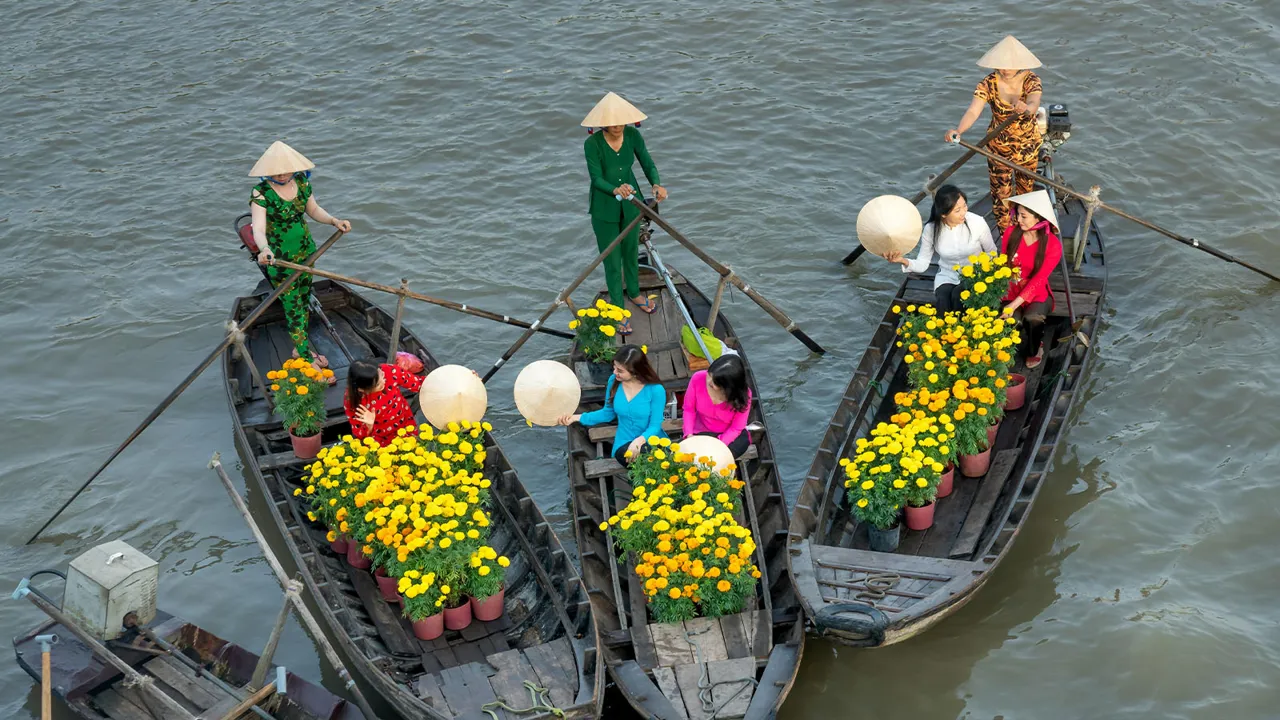
Hanoi – Hoa Binh – Mai Chau – Ninh Binh – Halong bay – Hue - Danang – Hoian – Saigon – Ben Tre - Can Tho – Saigon - Siem Reap Angkor - Tonlé Sap - Siem Reap – Ta Prohm - Departure

Authentic Hoang Su Phi Trekking Tours
Hoang Su Phi trekking tours take you to stunning terraces, meet few tourists, connect with locals and enjoy authentic culture.

Honeymoon Tour Packages In Vietnam 12 Days
Saigon Arrival - City Tour – Mekong Delta – Danang – Hoian - by flight - Da Nang – Hanoi - by flight – Halong - overnight on junk – Departure
Are you interested in this tour?


Our testimonials
Whether it's a short or long tour, to discover must-see sites or to travel less-traveled paths, by car, junk, on foot, by bike or by motorbike... upon their return from their trip to Indochina, our clients tell us about their experiences. We thank them for entrusting us with the organization of their stay in Vietnam, Cambodia, Laos, Thailand and Myanmar!
Tailor-made trips to Vietnam
Are you a couple, a family, a group of friends? Are you planning a trip to Vietnam and/or Southeast Asia? Or maybe you want an individual, personalized trip, operated directly by a local agency? Perhaps you're thinking of a customized trip accompanied by a perfectly French-speaking guide and a private car with a professional driver... Are you the kind of traveler who likes to go where others don't? Our tailor-made tours adapt to your desires, your choices, your pace and your budget.... You decide, we create a trip that suits you!


Don't miss anything from Southeast Asia
The press talks about us




Comment
No comments yet. Be the first to leave a comment!